MaksArtGallery
Vintage Oil Painting After Jacob van Loo Portrait, Signed Raynolds, Gold Frame
Vintage Oil Painting After Jacob van Loo Portrait, Signed Raynolds, Gold Frame
Couldn't load pickup availability
A beautiful vintage oil painting on canvas inspired by the celebrated 1658 portrait Portrait de jeune garçon au chien (Portrait of a Young Boy with a Dog) by Dutch Golden Age painter Jacob van Loo (1614–1670).
This captivating hand-painted reproduction depicts an elegantly dressed young boy standing beside his devoted black-and-white dog. The young gentleman wears a luminous white garment with delicate folds and a broad collar, complemented by magnificent crimson-red drapery that cascades gracefully across the composition. His softly illuminated face, long chestnut-brown hair, and gentle expression create a wonderful sense of innocence, refinement, and classical elegance.
Beside the child, a charming spaniel-like dog looks upward with an affectionate and attentive expression, introducing warmth and companionship into the formal portrait. The dramatic burgundy curtain on the right contrasts beautifully with the soft blue sky, delicate clouds, and verdant countryside visible in the background.
The painting captures the rich visual language of seventeenth-century Dutch portraiture, combining carefully modeled facial features, elegant fabrics, atmospheric lighting, and a sophisticated arrangement of color and form. Deep reds, creamy whites, warm flesh tones, and subtle greens create a harmonious and visually striking composition.
The original painting by Jacob van Loo, completed in 1658, belongs to the French national collections and is held by the Louvre's Department of Paintings, on long-term loan to the Musée Baron Martin in Gray, France.
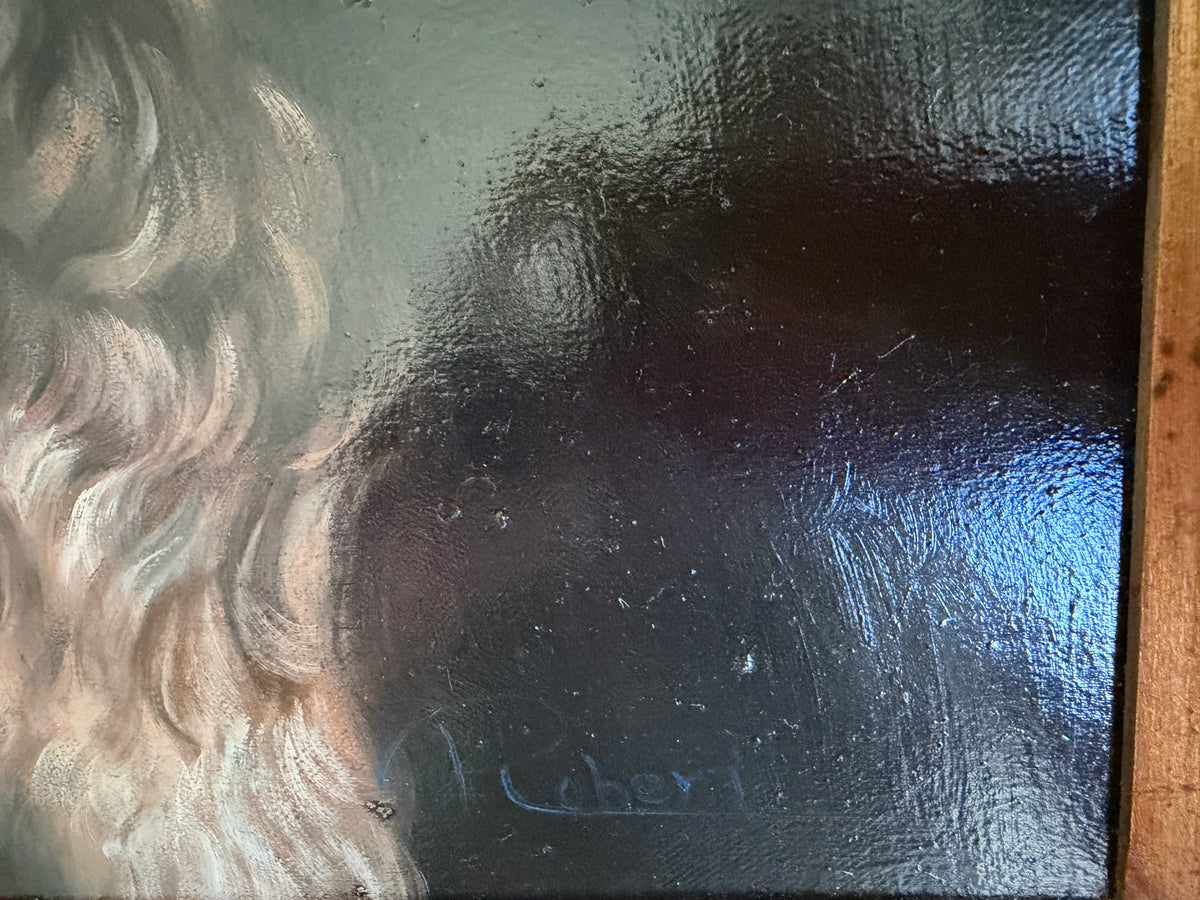
This vintage reproduction is executed in oil on canvas and bears a signature reading “Raynolds” in the lower left corner, together with an additional inscription appearing to read “Robert” on the right. The identity of the copyist has not been established.
The canvas is attached to its wooden stretcher with nails rather than modern staples, a construction detail consistent with traditional canvas-stretching methods. The exact date of this reproduction remains unknown.
The painting is beautifully presented in a substantial, elaborately ornamented gold-tone frame featuring intricate floral decorations, scrolling foliage, and richly modeled architectural details. The impressive frame enhances the historical character of the portrait and makes it a striking statement piece for a traditional living room, library, study, or elegant period-inspired interior.
📏 Measurements: Painting 24" × 20"; Framed 34" × 30".
🎨 Artist: Unidentified copyist, after Jacob van Loo (Dutch, 1614–1670).
✍️ Signature: Signed “Raynolds” lower left; additional inscription appearing to read “Robert” on the right.
🩺 Condition: Good vintage condition with age-appropriate wear. Traditional nail-fastened canvas construction. Please examine all photographs, including close-ups and the reverse.
📦 Shipping: Same-day safe packaging from Florida with tracking.
About the Artist — Jacob van Loo (1614–1670)
Jacob van Loo was a distinguished Dutch Golden Age painter, celebrated for his elegant portraits, mythological compositions, and sophisticated genre scenes. Born in Sluis in 1614, he received his early artistic training from his father, Jan van Loo, who was also a painter.
By 1642, Jacob van Loo was established in Amsterdam, where he developed a successful artistic career. His early works were influenced by Flemish painting, particularly the elegant compositions and refined portraiture of Anthony van Dyck. During the 1650s, he became increasingly recognized for his intimate genre scenes and accomplished portraits, distinguished by graceful figures, expressive gestures, and subtle psychological characterization.
In 1658, Van Loo received important portrait commissions in Haarlem, further establishing his reputation as a leading portrait painter of his generation.
Following his departure from the Netherlands in 1660, Van Loo settled in Paris, where he continued his successful career. In 1663, he was admitted to the prestigious Académie Royale de Peinture et de Sculpture. His artistic legacy continued through subsequent generations of the Van Loo family, several of whom became prominent painters in France.
The original composition reproduced in the present painting, Portrait de jeune garçon au chien (1658), is a remarkable example of Van Loo's portraiture. It depicts an elegantly dressed young boy accompanied by a dog, combining aristocratic refinement with a tender representation of childhood.
The original oil painting measures approximately 88 × 75 cm and is part of the Louvre's Department of Paintings collection, currently on long-term loan to the Musée Baron Martin in Gray, France.
The present artwork is a later hand-painted reproduction after Jacob van Loo's original composition and is not attributed to Van Loo himself.
Collector's Note
This attractive vintage oil painting offers an opportunity to enjoy one of the elegant child portrait compositions of the Dutch Golden Age in a substantial, traditionally framed format.
The combination of the young gentleman's refined appearance, magnificent crimson drapery, affectionate companion dog, and atmospheric landscape background creates a timeless and emotionally engaging subject.
Of particular interest are the painting's traditional nail-fastened canvas construction, visible inscriptions, and richly ornamented gold-tone frame. These characteristics contribute to its appeal as a decorative vintage work, although the precise date and identity of the copyist remain undetermined.
The painting would make an impressive addition to a collection of vintage European-style portraits, Dutch Golden Age-inspired artwork, or traditional decorative fine art.
Please note: Colors may vary slightly due to lighting, camera quality, and screen settings. We sell vintage and antique items, which may show signs of age such as craquelure, patina, scuffs, or retouching. These characteristics add authenticity and historical value to the artwork. Please review all photographs carefully, as they form part of the description.